The-Real-Cost-of-Poor-Quality-How-Defects-Are-Silently-Eating-Your-Profit-Margins-
Smarter Processes. Better Quality. Stronger Results.
The-Real-Cost-of-Poor-Quality-How-Defects-Are-Silently-Eating-Your-Profit-Margins-
Smarter Processes. Better Quality. Stronger Results. , Aug-25-2026
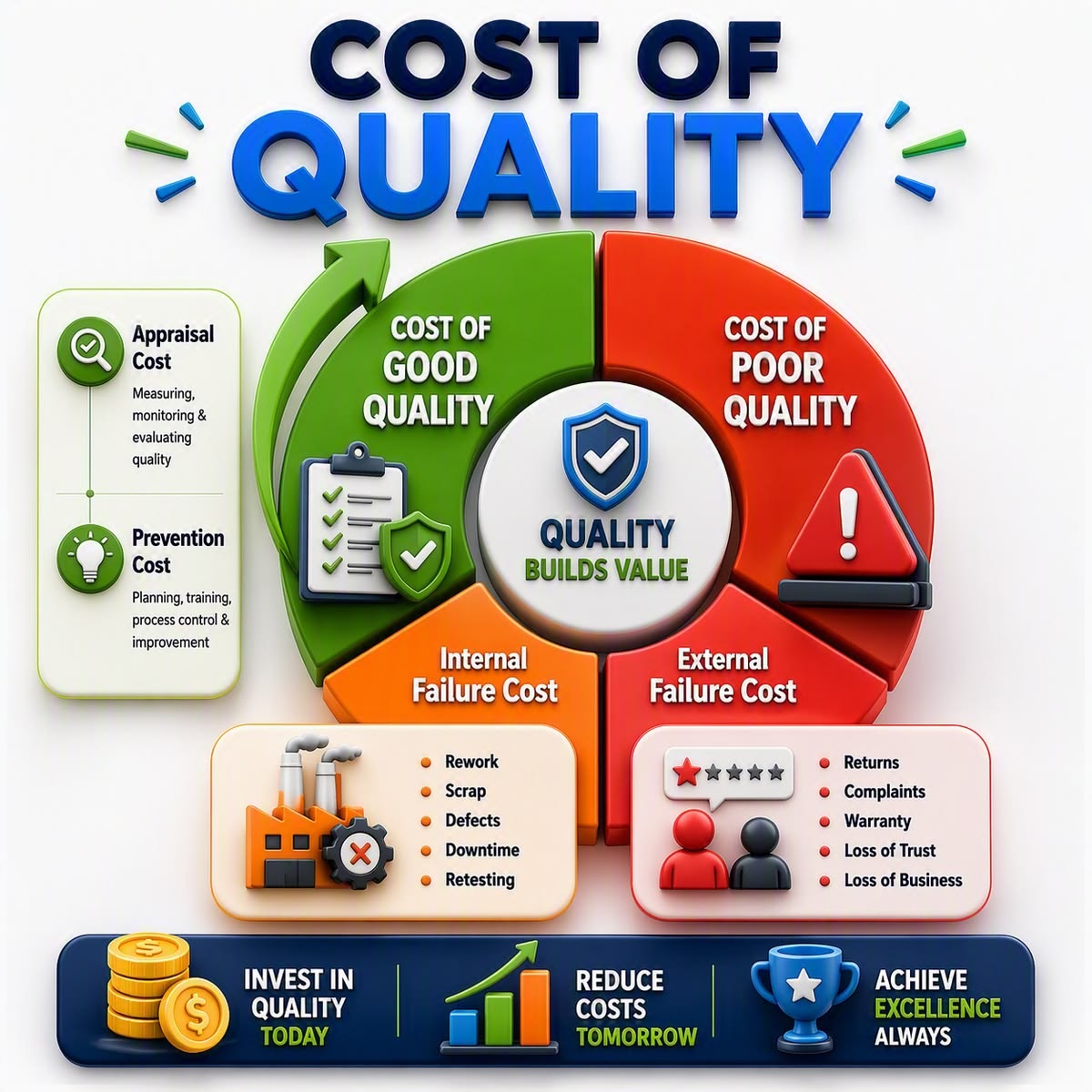
A plant manager once told us his factory had "a 2% defect rate, nothing to worry about." When we sat down with his finance team, that 2% translated to rework, scrap, expedited freight, and customer claims worth nearly 6% of annual revenue. He wasn't lying. He just wasn't measuring the right thing. This is the pattern we see across almost every organisation we walk into as a TQM consultant in India: the defect rate on the shop floor and the defect cost on the P&L statement are two completely different numbers, and most leadership teams look at only the first. Poor quality doesn't announce itself with a single catastrophic failure. It erodes margins quietly, one rework cycle, one warranty claim, one missed delivery at a time. By the time it shows up in quarterly numbers, it's already been happening for months. Why "Cost of Poor Quality" Is Bigger Than You Think In our experience, most finance and operations teams track the visible cost of quality, scrap material, rework labour, and warranty payouts. What they miss is the much larger, hidden layer beneath it. The Cost of Poor Quality (COPQ) typically falls into four buckets: Internal Failure Costs Scrap, rework, re-inspection, and downtime caused by catching a defect before it reaches the customer. This is the cost everyone sees. External Failure Costs Returns, warranty claims, field service visits, and the one nobody numbers: lost repeat business. A customer who receives one bad batch rarely tells you they're leaving. They just stop ordering. Appraisal Costs The inspection, testing, and audit effort spent trying to catch problems before they escape. This cost exists because the process can't produce right-first-time output, and it grows every year a business doesn't fix the root cause. Prevention Costs Ironically, this is usually the smallest bucket: training, process control, and root-cause work, even though it's the only category that actually reduces the other three. What most people don't realise is that internal and external failure costs alone can run between 15-25% of revenue in organisations that haven't formalised their quality systems. That's not a rounding error. That's often the entire operating margin. Visit: https://arrowheadco.net/six-sigma-consultant-in-india/ Where the Leakage Actually Happens Here's where things get interesting: the leakage rarely happens where companies expect it to. On the production line, defects are usually visible and get fixed fast because they stop the line. The real damage happens upstream, in specification errors, supplier variation, and handoffs between departments where nobody owns the outcome end-to-end. In services and back-office functions, the equivalent of a "defect" is a wrong invoice, a data entry error, a missed SLA, or a customer query that gets escalated three times before it's resolved. These rarely get costed at all, which is why service businesses often underestimate their COPQ the most. In procurement, incoming material variation quietly inflates downstream rejection rates, and by the time it's traced back to a supplier, months of rework costs have already accumulated. As a Lean consultant in India working across manufacturing, FMCG, automotive, and financial services, we've found the businesses with the highest hidden COPQ are almost always the ones that measure quality in percentages instead of rupees. A 98% first-pass yield sounds excellent on a dashboard. Translate that 2% into cost, delay, and customer impact, and the story changes completely. Why Inspection Alone Never Fixes This A natural response to rising defects is to add more inspection. More checkpoints, more sign-offs, more QA headcount. It feels productive, and it rarely solves the underlying problem. Inspection catches defects. It doesn't prevent them. Every rupee spent on appraisal is a rupee spent managing a symptom rather than curing the cause. Organisations that rely on inspection as their primary quality strategy end up in a permanent holding pattern: costs stay high, appraisal spend keeps climbing, and the defect rate barely moves year over year. This is precisely the gap that structured Six Sigma consultants in India are brought in to close, not by adding more checking, but by using root-cause analysis, process capability studies, and statistical control to design the defect out of the process itself. The DMAIC framework exists for exactly this reason: define the problem in financial terms, measure the real defect rate, analyse the root cause, improve the process, and control it so the gain sticks. Visit: https://arrowheadco.net/tqm-consultant/ Turning Quality Into a Margin Lever, Not a Cost Centre The organisations that get this right treat quality as a P&L conversation, not a compliance checkbox. A few shifts we consistently see make the difference: Cost the defect, not just the rate. A 3% defect rate on a high-value line can cost more than a 10% defect rate on a low-value one. Prioritise fixes by rupee impact, not by volume. Build Voice of Customer into the process, not just the survey. Many "quality" problems are actually specification problems: the product was built exactly to spec, and the spec was wrong. Feeding customer expectations back into process design earlier catches this before it becomes a defect. Standardise before you automate. Businesses exploring AI-driven quality checks often skip standardising the underlying process first, so they end up automating inconsistency faster rather than removing it. Make prevention visible alongside failure cost. When leadership can see prevention spend and failure cost side by side, the business case for investing upstream becomes self-evident. The Bottom Line Poor quality rarely shows up as a single dramatic loss. It shows up as a slow, compounding tax on margin, one that's easy to ignore precisely because it's spread across a hundred small inefficiencies instead of one big one. The good news is that this is one of the most measurable, fixable problems in any operation, once someone actually puts a rupee figure against it. That's the starting point of almost every engagement we run, not a training module, but a clear-eyed look at what defects are actually costing the business today. If your team has never formally costed its quality gaps, that's usually the first conversation worth having. Whether the fix ends up being process redesign, supplier quality work, or a structured Lean Six Sigma rollout, the first step is the same: measure what poor quality is really costing you, and work backwards from there. Visit: https://arrowheadco.net/
Discover how poor quality silently impacts profit margins and learn how Lean Six Sigma can reduce defects, waste, rework, and hidden costs.
Popular
- TQM Consultant In India
- Six Sigma Consultants In India
- Lean Consultant In India
- Arrowhead Consulting
Shopeze.in
Boost via Reels & Images
Learn Python By Gagan Khanna
Professional Help for Growth
Tags
TQM Consultant In India Six Sigma Consultants In India Lean Consultant In India Arrowhead Consulting