SDG-10-Reduced-Inequalities
Creating Equal Opportunities for All Author: Ishika Agarwal | CHRIST (Deemed to be University), Delhi NCR Campus | 3 BBA FMA B
SDG-10-Reduced-Inequalities
Creating Equal Opportunities for All Author: Ishika Agarwal | CHRIST (Deemed to be University), Delhi NCR Campus | 3 BBA FMA B , Aug-27-2026
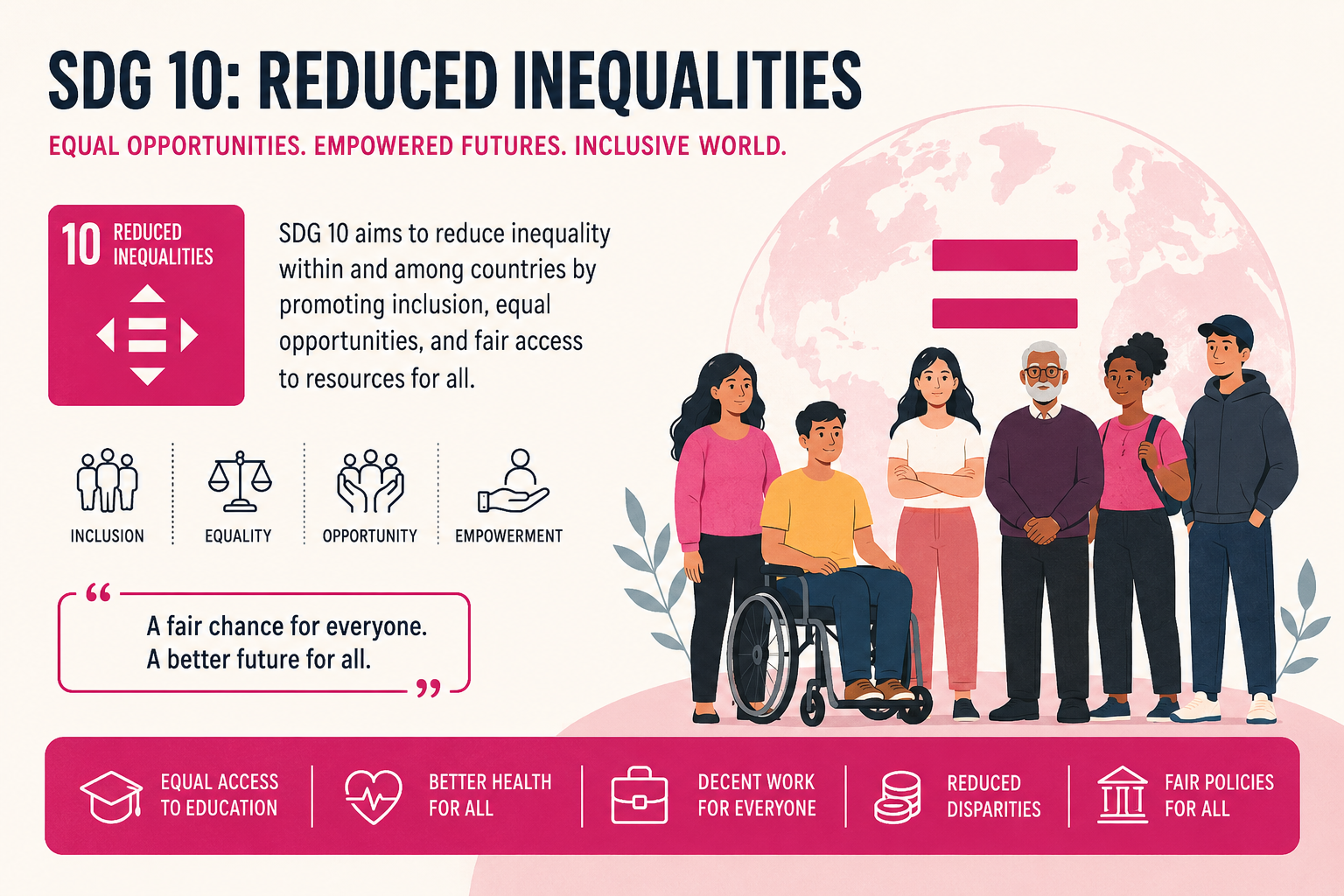
SDG 10: Reduced Inequalities Everyone should have the same chance to live a safe, successful, and meaningful life, but inequality still has an impact on millions of people all over the world. Sustainable Development Goal 10 (SDG 10), introduced by the United Nations, aims to reduce inequality both within and between countries. It focuses on building a society where every individual, regardless of their background, income, gender, age, disability, or social status, has equal access to opportunities and can fully participate in society. Inequality is not only about differences in income or wealth; it is also seen in access to education, healthcare, employment, technology, financial resources, housing, and social opportunities. For example, children from low-income families may not have the same access to quality education, digital resources, and learning opportunities as children from wealthy families. Similarly, people with disabilities may face obstacles when seeking employment or using public facilities. Such inequalities can prevent individuals from developing their capabilities and achieving their goals. The aim of SDG 10 is to promote social, economic, and political inclusion for all. A key objective is to improve the income and standard of living of the poorest 40 per cent of the population. It also encourages governments to create policies that reduce discrimination and ensure equal opportunities. The goal goes beyond simply supporting disadvantaged groups; it is also about creating systems where people can participate, contribute, and progress with dignity. Reducing inequality is especially important in India because there are significant differences in income, education, employment, healthcare, and access to basic services. Although progress has been made in many areas, people still face difficulties due to poverty, lack of awareness, limited resources, and social barriers. The government has introduced various initiatives, including scholarships, skill-development programmes, financial inclusion schemes, and welfare programmes. However, these programmes are effective only when people are aware of them, understand how to apply, and can access their benefits without unnecessary difficulties. Education plays an important role in reducing inequality. By providing knowledge, skills, confidence, and better employment opportunities, quality education can make a significant difference. Educational institutions can create inclusive environments where students have a fair opportunity to participate, express their opinions, develop their talents, and use available resources. Teachers and students can also promote respect and understanding among people from different social and economic backgrounds. Technology is another important factor in promoting equality. It allows people to learn new skills, find employment, access financial services, and connect with information. However, the digital divide can create another form of inequality among people who do not have smartphones, computers, reliable internet connections, or the skills needed to use technology. Therefore, improving digital literacy and ensuring affordable access to technology is essential for creating equal opportunities. Young people can also contribute to reducing inequality through simple actions such as respecting people from different backgrounds, opposing discrimination, raising awareness, volunteering, and helping others access educational and career opportunities. Social media and other digital platforms can be used to spread positive messages about inclusion and equality. When individual actions come together, they can create meaningful social change. Reducing inequality does not mean that everyone must have the same income, lifestyle, or circumstances. It means that everyone should have a fair opportunity to improve their lives. A person’s economic situation, family background, gender, disability, or social circumstances should not determine the achievements they can make. Equality means removing unfair barriers and providing opportunities based on a person’s ability, effort, and potential. Businesses and organisations also have an important role to play. They can promote fair employment practices, provide equal opportunities, support diversity, and create safe and inclusive workplaces. Governments can improve policies and social protection systems, while communities can encourage cooperation and support vulnerable groups. Only when all parts of society work together can reducing inequality become a shared responsibility. To sum up, SDG 10 stands for a world in which no one is left behind. Governments, educational institutions, businesses, organisations, communities, and individuals must make continuous efforts to promote fairness, inclusion, awareness, and equal access to opportunities. A more equal society is not only better for individuals but also contributes to social stability, economic growth, peace, and a sustainable future. In the end, reducing inequality means ensuring that every person has a fair opportunity to learn, grow, participate, and succeed.
The goal of SDG 10: Reduced Inequalities is to establish a fair and inclusive society in which all people have equal opportunities no matter their income, background, gender, age, disability, or social status. This article stresses the need to reduce inequalities in the areas of education, healthcare, employment, technology, and access to essential services, with a special focus on India. It also describes how governments, educational institutions, businesses, and young people can collaborate in order to eliminate unfair obstacles, promote inclusion, and make sure that each individual is given a fair opportunity to learn, develop, take part, and achieve success.
Popular
- Reduced Inequalities
- Equal Opportunities
- Social Inclusion
- Sustainable Development
Shopeze.in
Boost via Reels & Images
Learn Python By Gagan Khanna
Professional Help for Growth
Tags
#SDG10 #ReducedInequalities #SustainableDevelopmentGoals #Equality #Inclusion #EqualOpportunities #SocialEquality #EconomicEquality #India #YouthForChange #EducationForAll #DigitalInclusion #NoOneLeftBehind #SustainableDevelopment #UnitedNations