Life-Below-Water
The Ocean Is Not a Dustbin: Why Saving Life Below Water Is Saving Ourselves
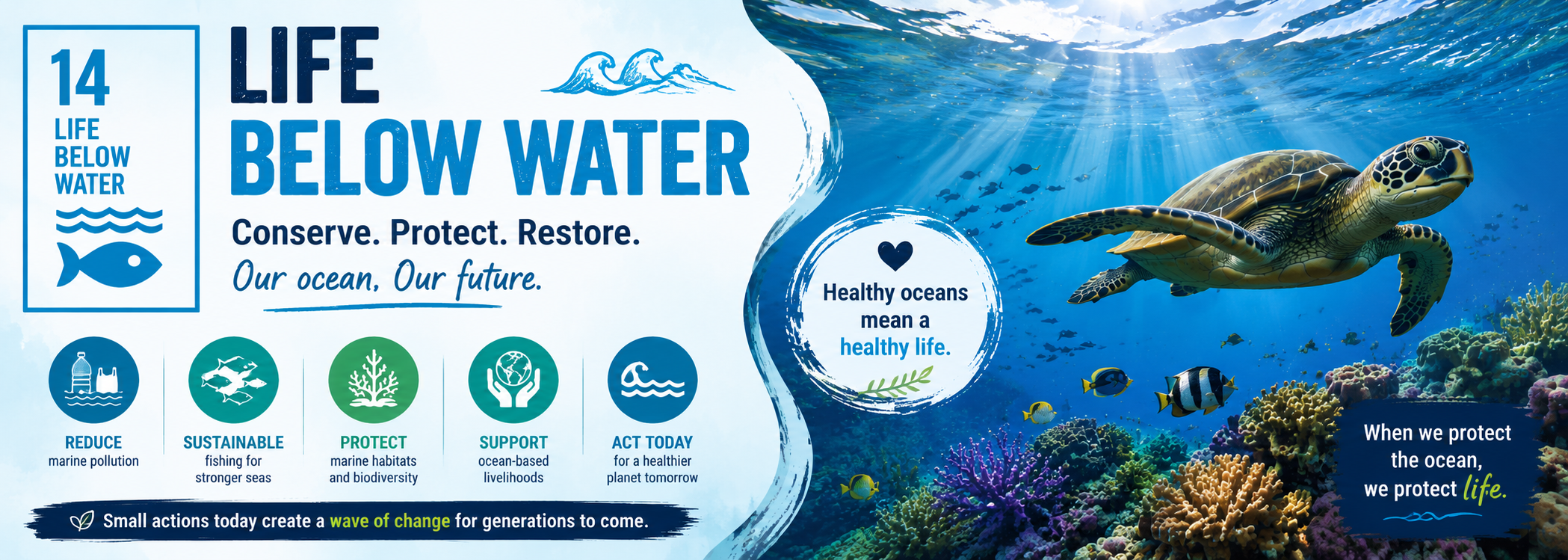
Life-Below-Water
The Ocean Is Not a Dustbin: Why Saving Life Below Water Is Saving Ourselves , Aug-29-2026
By Nandini Talwar 3 BBA FMA B From CHRIST(deemed to be University), Delhi NCR Campus, Ghaziabad. The Ocean Is Not a Dustbin: Why Saving Life Below Water Means Saving Ourselves” explores the urgent need to protect the world’s oceans and marine ecosystems through the lens of Sustainable Development Goal 14 (SDG 14): Life Below Water. Covering more than 70 per cent of the Earth’s surface, oceans are fundamental to life on our planet. They regulate the climate, support biodiversity, provide food and employment, facilitate transportation and sustain millions of people whose livelihoods depend directly or indirectly on marine resources. Despite their importance, oceans are increasingly threatened by human activities, including plastic pollution, untreated wastewater, chemical waste, overfishing, habitat destruction and climate change. The article begins by challenging the common perception that ocean-related environmental problems are distant from our everyday lives. In reality, what happens on land can have serious consequences for marine ecosystems. A plastic bottle or food wrapper discarded on a street can enter drainage systems, rivers and eventually the sea. Once in the ocean, plastic can injure or kill marine animals through ingestion and entanglement and can gradually break down into smaller particles that enter marine food chains. This demonstrates how seemingly small individual actions can contribute to a much larger global environmental crisis. The article also highlights overfishing as a major threat to marine biodiversity and food security. Unsustainable fishing practices can reduce fish populations, disturb marine food chains and affect communities that depend upon fisheries for their income and nutrition. Protecting marine resources therefore requires a balance between human needs and the long-term health of marine ecosystems. Another major focus of the article is the relationship between climate change and ocean health. Oceans absorb significant amounts of carbon dioxide and heat from human activities, helping to regulate the Earth’s climate. However, this comes with serious consequences for marine ecosystems. Increasing carbon dioxide levels contribute to ocean acidification, while rising ocean temperatures place additional pressure on marine organisms and habitats. Coral reefs, in particular, are highly vulnerable to changes in temperature and ocean chemistry. Coral bleaching can damage entire ecosystems because reefs provide shelter, breeding grounds and food sources for numerous marine species. The article places particular emphasis on India’s connection with the ocean. With its extensive coastline and large number of coastal communities, India depends heavily on healthy marine and coastal ecosystems. Fisheries, coastal tourism, transportation and other economic activities are closely connected to the ocean. India’s marine environment also includes valuable ecosystems such as coral reefs, mangroves, estuaries and seagrass habitats. Damage to these ecosystems can have consequences that extend beyond environmental degradation, affecting livelihoods, food security, tourism and coastal resilience. The article argues that protecting India’s oceans requires more than occasional beach-cleaning campaigns. While such initiatives can create awareness and remove existing waste, long-term conservation requires systematic solutions. Effective waste management, responsible consumption, sustainable fishing practices, protection of marine habitats and stronger implementation of environmental policies are all essential. A central message of the article is that responsibility for ocean conservation cannot rest solely with governments. Individuals, educational institutions, businesses and communities all have important roles to play. Individuals can reduce unnecessary single-use plastic, avoid littering, segregate waste and make environmentally responsible choices. Educational institutions can encourage students to participate in awareness campaigns, environmental projects and conservation activities. Businesses can reduce unnecessary packaging, improve waste-management practices and adopt more sustainable production methods. Governments can strengthen environmental regulations, protect marine habitats and promote sustainable fisheries. The article also emphasises the importance of transforming awareness into action. SDG 14 should not be viewed simply as one of the 17 Sustainable Development Goals listed by the United Nations. It should be understood as a shared responsibility that connects environmental sustainability with human well-being. Protecting marine ecosystems contributes to several other development goals, including poverty reduction, food security, decent work, climate action and reduced inequalities. The concluding section presents the ocean not as something separate from human society, but as a system closely connected to our survival. A polluted coastline can affect tourism and local communities. Declining fish populations can threaten food security and fishermen’s livelihoods. Damaged coral reefs and mangroves can reduce the natural protection offered to coastal areas. Changes in ocean temperature and chemistry can also contribute to wider disruptions in the Earth’s climate system. The article therefore asks readers to reconsider how they view the ocean. The ocean is not an infinite resource and it is certainly not a place where humanity can permanently hide its waste. Every action taken on land can eventually have consequences in the water. The products we consume, the waste we generate, the energy we use and the resources we demand are all connected to marine health. At its core, the article argues that saving life below water is ultimately about saving ourselves. Marine conservation is not merely about protecting fish, coral reefs, turtles or other ocean species. It is about protecting food systems, livelihoods, biodiversity, climate stability and the well-being of future generations. SDG 14 provides a global framework for addressing these challenges, but achieving its objectives requires meaningful participation from society as a whole. Governments can create policies, scientists can provide evidence, organisations can conduct conservation programmes and businesses can adopt sustainable practices, but individual choices also matter. The article ends with a call for collective responsibility and immediate action. Humanity still has the opportunity to change its relationship with the ocean, but meaningful change cannot be postponed indefinitely. Future generations should inherit oceans that are healthy, diverse and capable of supporting life—not ecosystems damaged beyond recovery. “The Ocean Is Not a Dustbin” is ultimately a reminder that the health of the ocean and the health of humanity are deeply interconnected. If we want a sustainable future on land, we must also protect the world beneath the waves. Life Below Water is not simply an environmental goal; it is an essential part of building a healthier and more sustainable planet for everyone.
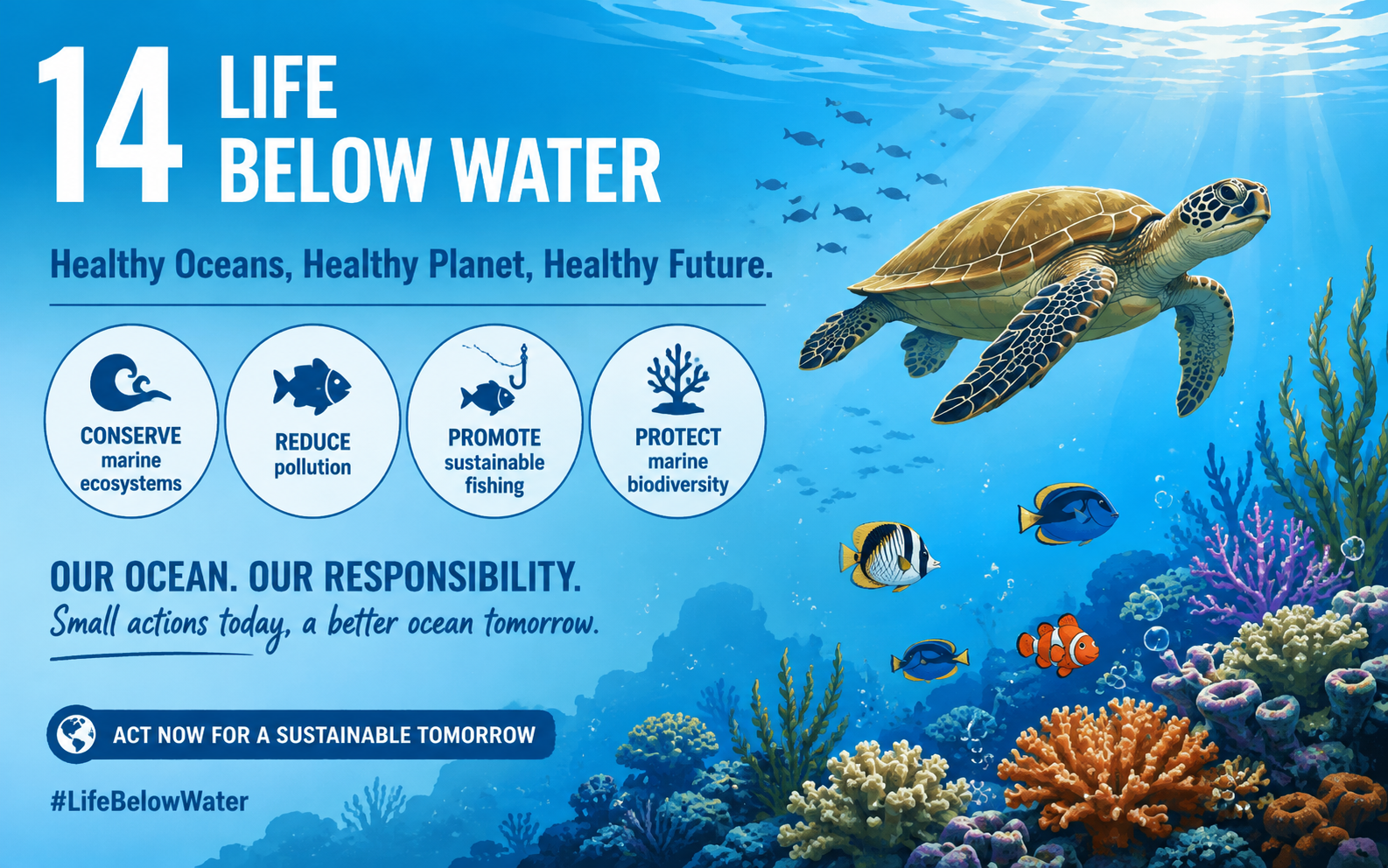
Our oceans are more than vast bodies of water—they are essential to life on Earth. Yet, marine ecosystems are facing growing threats from plastic pollution, overfishing, climate change, ocean warming and acidification. This article explores SDG 14: Life Below Water, a global commitment to conserve and sustainably use oceans, seas and marine resources. It highlights the importance of healthy oceans to biodiversity, livelihoods, food security and climate regulation, with a particular focus on India’s dependence on its coastal and marine ecosystems. The article also examines how everyday human activities contribute to ocean degradation and why protecting marine life requires collective action from individuals, businesses and governments. Ultimately, it argues that saving life below water is not simply an environmental responsibility—it is essential for protecting our own future and ensuring a healthier planet for generations to come.
Popular
- SDG-14 Life Below Water
- Marine Conservation
- Ocean Pollution
- Climate Change
Shopeze.in
Boost via Reels & Images
Learn Python By Gagan Khanna
Professional Help for Growth
Tags
SDG-14 Life Below Water Marine Conservation Ocean Pollution Climate Change