Drone Training Course In Delhi: Fees, Rules & Career Guide
Fly Legal, Fly Smart: Choose The Right Drone Course In Delhi.
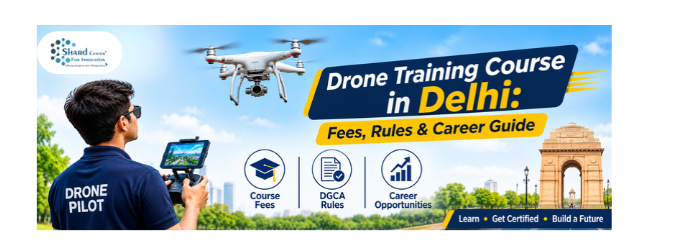
Drone Training Course In Delhi: Fees, Rules & Career Guide
Fly Legal, Fly Smart: Choose The Right Drone Course In Delhi. , Nov-18-2026
You can’t just buy a drone in Delhi and fly it over India Gate. In fact, you can’t fly it over most of the capital at all. That single fact is why a proper drone training course in Delhi matters: the city has some of the strictest airspace in the country, and the people who learn to work inside those limits are the ones who find steady work. Whether you want to shoot weddings, map land, inspect buildings or simply build a career in a fast-growing field, this guide explains what the training involves, who can join, and how to avoid the common traps.
Why a drone training course in Delhi is worth considering
Delhi and the wider NCR are a practical base for learning. You are close to media houses, real estate developers, survey firms, infrastructure companies and event agencies, all of which hire drone operators or buy aerial work from freelancers. Many of the people who take this route are photographers adding a new service, engineering students looking for a skill edge, or working professionals thinking about a side income.
A good course does more than teach you to hover. It teaches you to read airspace, plan a mission, follow the law and handle a drone calmly when something goes wrong. That last part is what clients are really paying for.
What you actually need to know about the rules first
India’s Drone Rules, 2021 are the framework most training programs are built around. In plain language, here is what that means for you.
- Training must happen at an authorised institution. A Remote Pilot Certificate (RPC) is obtained through training at a DGCA-authorised Remote Pilot Training Organisation, usually called an RPTO.
- Age and education. The widely cited eligibility is 18 to 65 years of age and a Class 10 pass or equivalent.
- Validity. A remote pilot certificate is generally valid for up to ten years, subject to the conditions DGCA sets, and it is recorded on the Digital Sky platform.
- Medical fitness. Requirements here have been described differently across sources, so confirm the current medical or self-declaration requirement with your training provider and DGCA.
Rules get amended, so treat this article as a starting map, not legal advice. Before paying anyone, check the latest position on DGCA and Digital Sky.
Drone training course in Delhi: what the syllabus should cover
This is the part most beginners skip, and in Delhi it is the part that gets people into trouble. The capital contains an international airport, government buildings, defence installations and many sensitive areas. A large share of it falls under restricted airspace.
A simple way to think about it:
- Green zones need no special permission within the allowed height limits.
- Yellow zones need permission from the relevant air traffic authority.
- Red zones are off limits without specific approval.
Your trainer should show you the Digital Sky airspace map and teach you how to check a location before every flight. In practice, many Delhi students do their outdoor practice at designated open areas or just outside the city, where the zone situation is clearer.
Who should take a drone training course in Delhi?
Not everyone needs the same thing. Here is how different people tend to use the certification:
- Photographers and videographers: weddings, real estate, tourism, music videos.
- Engineering and science students: a hands-on skill that pairs well with AI, mapping and robotics projects. If you are still building your foundation, the short courses for professionals from Shard Center for Innovation show how technical programs can be structured for working learners.
- Surveyors and civil professionals: site monitoring, progress tracking, volumetric measurement.
- Agriculture and field service professionals: crop monitoring and inspection work.
- Career changers: people who want to enter a newer field with realistic, skills-based entry points.
How to choose the right institute
Prices and promises vary a lot. Use this checklist before you pay any advance.
- Ask for the authorisation details in writing. Confirm whether the institute is a DGCA-authorised RPTO or what its exact role is in your certification path. Then verify it independently on the official DGCA website.
- Count the flying time. Ask how many hours you personally get with the drone, not how many students share one machine.
- Meet the instructor. Look for someone with real field experience, not only a certificate on the wall.
- Request a full fee breakup. Exam fees, simulator charges, equipment and travel to the flying site should not appear as surprises later.
- Check the equipment. Are the drones maintained, and is there a backup if one fails during practice?
- Ask about placement or project support honestly. Be wary of guaranteed jobs. Reasonable support means portfolio help, referrals or project exposure.
- Read recent student feedback. Look for specifics about teaching quality rather than general praise.
If you want to see how one institute describes its programme, the drone training course page at Shard Center for Innovation is a useful example to compare against others. It is headquartered in Noida, which sits in the Delhi NCR.
Careers and earning paths after certification
A certificate gives you permission to work legally; it does not hand you clients. People who do well usually combine the licence with a specialisation:
- Aerial photography and videography for events, property and brands
- Mapping and surveying using photogrammetry software
- Inspection services for rooftops, towers, solar plants and construction sites
- Agriculture services such as spraying and field analysis, where regulations are more specific
- Training and content once you have solid experience
Income depends heavily on location, skill, equipment and how consistently you find work, so treat any specific monthly figure you see online with caution. Whichever provider you consider, ask directly about their certification status and use the admissions page or the centres list to find out which location suits you.
Mistakes beginners make and how to avoid them
- Buying an expensive drone before completing training. Learn first, then buy based on your actual use case.
- Ignoring weather and battery limits. Most early accidents come from rushed, careless flights.
- Flying “just once” in a restricted area. Penalties and equipment seizure are not worth it.
- Choosing only on price. The cheapest course often saves money by cutting flying time.
- Skipping logbook habits. Clean records help with insurance, clients and renewals.
Frequently asked questions
Q1: Can I join if I am still in school?
Ans: The commonly stated minimum age for a remote pilot certificate is 18, so younger students usually cannot receive it. They can still learn related skills such as basic drone concepts, coding, and electronics through STEM programmes.
Q2: Do I need to own a drone to start the course?
Ans: No. Training institutes normally provide the drones for practice. It is smarter to decide what to buy after you know what kind of work you want to do.
Q3: Is a Delhi drone certificate valid in other states?
Ans: A remote pilot certificate is a national credential, not a city-level one. However, every location you fly in still needs its own airspace check and any required permission.
Q4: What happens if I fail the test?
Ans: Policies differ by institute. Ask in advance whether retakes are included, how many are allowed, and whether they cost extra.
Q5: Can I fly a tiny drone at home without any certificate?
Ans: Very small (nano) drones for non-commercial use are treated differently under the rules, but restricted zones and local laws still apply. Check the current rules before flying, especially in Delhi.
Q6: How long does the training usually take?
Ans: Duration varies by institute and category, from a short intensive format to a spread-out schedule with theory and practical sessions. Ask for the exact hours and the assessment structure before enrolling.
Q7:Will this course help me if I want to work in agriculture or mapping, not photography?
Ans: It gives you the legal and flying foundation, but you will probably need extra practice with the specific payloads and software for those fields. Ask whether your institute offers follow-up modules.
Q8: How do I know my certificate will be recognized?
Ans: Verify that the institute is authorised and that your certificate is issued and listed through the official Digital Sky system. Do not rely only on an institute’s brochure or social media post.
Q9: What should I do right after finishing the course?
Ans: Build a small portfolio, practise in permitted areas, get the right insurance for your work and start with local projects before taking on bigger contracts.
Planning a drone training course in Delhi? Learn eligibility, DGCA rules, what to study, how to pick a trainer and careers after certification. Start here.
Popular Keywords
-
Drone Flying Class For Kids In India
-
Drone Training Course For Kids
-
Best Drone Flying Lessons For Kids
-
Drone Flying Training Courses In Noida
Shopeze.in
Shopeze.in
Aaja.in
Boost via Reels & Images
Learn Python
Learn Python By Gagan Khanna
Quick...
Professional Help for Growth
Tags
Drone Flying Class For Kids In India Drone Training Course For Kids Best Drone Flying Lessons For Kids Drone Flying Training Courses In Noida
























.png)


.png)

.png)




.png)







.png)
.png)
 NOW.png)
.pdf)

.png)







.png)






.jpeg)

.jpeg)

.png)






.png)
.png)
.png)


.png)






.jpg)


.jpg)


