Notes On Chapter Internet And Web IP Class XII CBSE
Find All Type Of Short Questions Fill In The Blanks True Or False Case Study For Class XII IP Internet And Web CBSE 065
Notes On Chapter Internet And Web IP Class XII CBSE
Find All Type Of Short Questions Fill In The Blanks True Or False Case Study For Class XII IP Internet And Web CBSE 065 , Sep-08-2026
Chapter 5: Internet and Web — Study & Revision Pack
📌 Section 1: Definitions (1-Mark Direct Concepts)
- Computer Network: An interconnection among two or more computers or computing devices to share data and resources.
- Node (Host): Any device connected to a communication network that can receive, create, store, or send data (e.g., computers, printers, routers).
- Ethernet: A set of standardized rules/protocols that determine how computers and devices connect and communicate via cables in a local network.
- Modem: A device that converts digital signals into analog signals (Modulation) at the sender's end and analog signals back into digital bits (Demodulation) at the receiver's end.
- MAC Address: A unique hardware address assigned to a Network Interface Card (NIC) to uniquely identify a device on a network.
- Network Topology: The physical or logical arrangement/layout of computers, cables, and peripherals in a network.
- URL (Uniform Resource Locator): A standard naming convention and web address that provides the exact location and access protocol for a resource on the World Wide Web.
- Web Server: A computer hardware or software system that stores website files and delivers them to client browsers upon HTTP requests.
- Dynamic Web Page: A web page whose content changes dynamically based on user interaction, database updates, or time-specific data.
- Cookie: A small text file saved on a user's browser by a website to store preferences, browsing history, and login sessions.
📝 Section 2: Short Notes (2 to 3 Marks)
1. Types of Networks (LAN vs. MAN vs. WAN)
- LAN (Local Area Network): Connects devices within a limited distance (up to 1 km) like a room, office building, or campus. Offers high data transfer speeds (10 Mbps to 1000 Mbps).
- MAN (Metropolitan Area Network): Covers a larger geographical area such as an entire city or town (extended up to 30–40 km). Example: Cable TV networks.
- WAN (Wide Area Network): Spans across cities, countries, or continents. The Internet is the largest example of a WAN.
2. Difference Between Hub and Switch
- Hub: A basic networking device that broadcasts incoming data to all connected ports, causing network congestion and data collisions.
- Switch: An intelligent device that inspects the destination address of arriving packets and forwards them
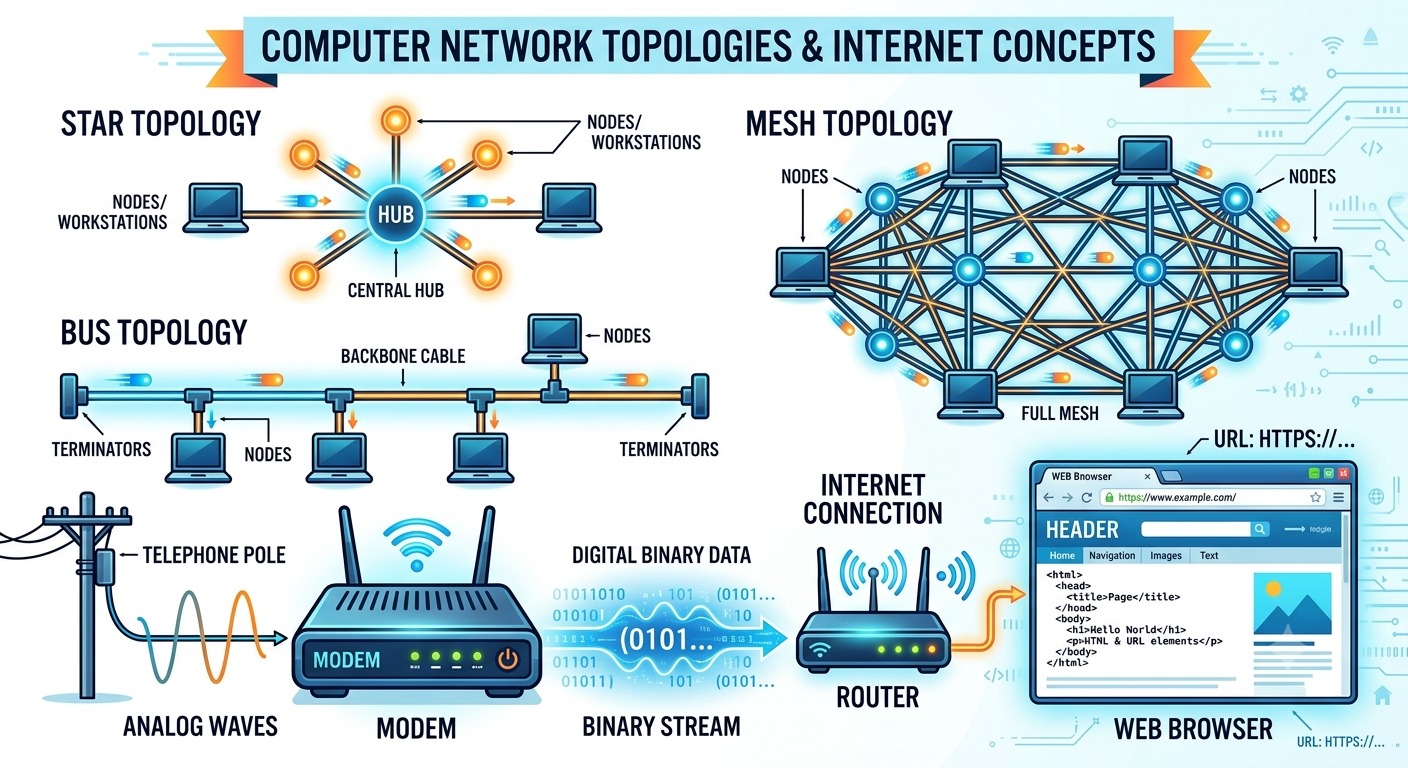
Internet and Web introduces the foundational concepts of modern computer networks, their architecture, and web technologies. It covers the physical and logical components that enable global communication, detailing network types (LAN, MAN, WAN), network topologies (Bus, Star, Tree, Mesh), and key hardware devices like modems, hubs, switches, routers, and gateways. Additionally, the chapter explores the structure and mechanics of the World Wide Web. It explains how digital content is accessed and transmitted using protocols like HTTP/HTTPS, IP and MAC addressing schemes, and the Domain Name System (DNS). Key web concepts including static versus dynamic web pages, browser functionalities (cookies, add-ons, and plug-ins), and real-time communication technologies like Voice over IP (VoIP) are also highlighted to give students a practical understanding of how internet services operate.
Popular Keywords
-
Class XII IP CBSE Code 065
-
Chapter 5 IP Class XII
-
Notes On Internet & Web
-
Internet & Web
Tags
Class XII IP CBSE Code 065 Chapter 5 IP Class XII Notes On Internet & Web Internet & Web